Product reviews and rating summaries#
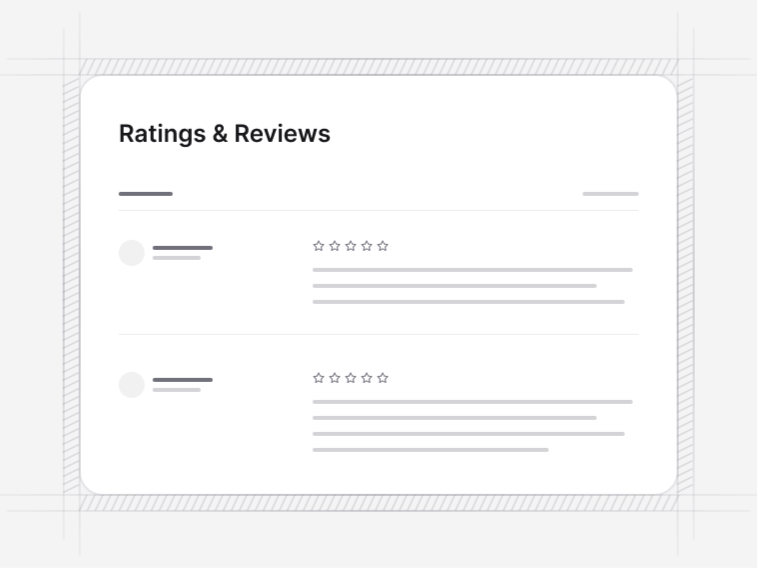
Reviews are the part of a product page a shopper trusts most and a shop controls least. These five cover the list, the distribution that gives a rating meaning, and the form that collects the next one.
The five review blocks#
- Product Review & Ratings 1: a paginated review list with reactions and a write-a-review form. Free.
- Product Review & Ratings 2: a rating summary with a per-star distribution above a review carousel. Free.
- Product Review & Ratings 3: a review list with a rating filter, distribution bars and pagination.
- Product Review & Ratings 4: a review section with per-category ratings, sort controls and a load-more action.
- Product Review & Ratings 5: a simple list with a rating distribution and helpful voting.
Why the distribution matters more than the average#
Four stars from thirty reviews and four stars from three are different products. So are four stars where most reviews are five with a few ones, and four stars where every review is a four. The distribution bars answer both questions in the space an average occupies, which is why the summary blocks lead with them.
Per-category ratings#
Review Rating 4 breaks the score into categories such as build quality, ease of use and value. This is the single most useful addition for products where people disagree predictably: a tool that is genuinely excellent and genuinely expensive gets a muddled average and a very clear category breakdown.
Collecting a review#
Review Rating 1 includes the write-a-review form, with the star control, a title, the body and the fields you need for attribution. Asking for a rating before the text is deliberate, since a person who has already clicked four stars is far more likely to write the sentence than one facing an empty textarea.
Review structured data, and when not to publish it#
Publish review markup only for reviews you actually collected. Marking up invented ratings is a policy violation rather than a shortcut, and it is exactly the claim search engines verify against the visible page. Ship the block first, collect real reviews, then add the markup once there is something true to describe.
Where reviews sit on a product page#
Below the buying decision on the product detail page, with the average and the count visible near the price so a shopper knows the section exists. The marketing testimonials are the company-level equivalent for a landing page, and order history is where a returning customer is prompted to leave one.